To solve circle theorem problems, first decide whether you need an angle or a length. For angles, locate the vertex and its intercepted arc. For lengths, identify tangents, chords or secants and label the relevant segments before choosing a formula.
A busy circle diagram can look like someone dropped spaghetti on a dinner plate. You do not need every line at once. Find the lines connected to your unknown, and start there.
The vocabulary varies by country. In UK courses, you may read angle at the centre and angle at the circumference. In US courses, the same ideas are usually called a central angle and an inscribed angle. The rules are identical.
Reliable method: mark the centre, identify the arc or chord shared by the angles, name the theorem, and only then substitute the known value.
Which circle theorem should I use?
A chord joins two points on the circle. A secant is a line crossing the circle at two points. A tangent touches it at one point. An arc is part of the circumference; its degree measure describes how much of the circle it spans, not its physical length.
| What the problem gives you | What to do |
|---|---|
| Angle at the center | Its measure equals the measure of its intercepted arc |
| Angle with vertex on the circle, formed by two chords | Use half the intercepted arc that does not contain the vertex |
| Two chords intersecting inside the circle | Angle = half the sum of the arcs intercepted by the angle and its vertical angle |
| Two secants, two tangents, or a tangent and secant meeting outside | Angle = half the difference of the larger and smaller intercepted arcs |
| Four vertices on the circle | Opposite interior angles total 180° |
| Radius meeting a tangent at the contact point | Mark a right angle |
| Two chords crossing inside; lengths given | Multiply the two pieces of each chord and set the products equal |
| Two secants from the same external point; lengths given | Outside × whole = outside × whole |
| Tangent and secant from the same external point; lengths given | Tangent² = outside × whole |
The angle formulas and length formulas answer different questions. If your answer is an angle, keep degrees. If it is a segment, use length units. A tangent cannot be “12 degrees long,” even if the homework has been a long evening.
The six circle theorems you need to know
| Theorem | Rule | What to look for |
|---|---|---|
| Centre and circumference | The angle at the centre is twice the angle at the circumference standing on the same arc. | Two angles whose sides meet the same two points on the circle. |
| Same segment | Inscribed angles intercepting the same arc are equal. | Two vertices on the same side of a chord, intercepting the same arc. |
| Semicircle | An angle at the circumference subtended by a diameter is . | A triangle whose longest side is a diameter. |
| Cyclic quadrilateral | Opposite interior angles add to . | All four vertices lie on one circle. |
| Radius and tangent | A radius is perpendicular to a tangent at the point of contact. | A radius ending exactly where a line touches the circle. |
| Alternate segment | The angle between a tangent and chord equals the angle in the opposite segment subtended by that chord. | A tangent-chord angle and an inscribed angle using the same chord. |
These rules depend on precise relationships, not on how the sketch looks. For example, the centre-and-circumference theorem works only when both angles stand on the same arc.
Worked example 1: central and inscribed angles
Problem: Points A and B lie on a circle with centre O. The central angle . Point C lies on the opposite part of the circumference. Find .
Both angles are subtended by endpoints A and B, so they stand on the same arc AB. The angle at the centre is twice the angle at the circumference:
Substitute the known angle:
Answer: .
The most common mistake is doubling . Check the direction of the rule: the central angle is the larger one, so the inscribed angle is half of it.
A same-segment extension
Suppose a second point D lies on the same side of chord AB as C. Angles and both stand on chord AB, so:
This uses the same-segment theorem rather than applying the centre rule again.
Worked example 2: angle in a semicircle
Problem: AB is the diameter of a circle and C is a point on the circumference. The diameter is , and . Find and the length .
Because AB is a diameter, the angle it subtends at C is a right angle:
Triangle ABC is therefore a right triangle with hypotenuse . Apply the Pythagorean theorem:
Answer: , and .
The theorem creates the right angle; the Pythagorean theorem then completes the length calculation. Do not assume the angle is unless the chord across from it is explicitly a diameter.
Worked example 3: cyclic quadrilateral
Problem: Quadrilateral PQRS is inscribed in a circle. If , find the opposite angle .
Opposite angles in a cyclic quadrilateral are supplementary:
Substitute and solve:
Answer: .
Adjacent angles in a cyclic quadrilateral do not necessarily add to . First trace across the quadrilateral to confirm that the two angles are opposite.
If side PS is extended beyond S, the exterior angle at S equals the interior opposite angle at Q. This follows because the exterior angle and form a straight line, while .
Worked example 4: tangent and chord
Problem: A tangent touches a circle at A. Chord AB forms a angle with the tangent. Point C lies on the major arc AB, so ∠ACB intercepts the minor arc AB. Find .
The angle between a tangent and a chord equals the angle in the alternate segment subtended by that chord. Both angles are associated with chord AB, so:
Answer: .
There is another useful fact at A. If O is the centre, radius OA is perpendicular to the tangent, so the angle between OA and the tangent is . Therefore the angle between OA and chord AB is:
Because OA and OB are radii, triangle AOB is isosceles. Its two base angles are both , giving the central angle:
This agrees with the centre theorem because . Using a second theorem to verify the answer is an excellent error check.
Worked example 5: intersecting chords and missing lengths
Problem: Chords AB and CD intersect at P inside a circle. AP = 3 cm, PB = 8 cm, CP = 4 cm. Find PD.
The intersecting chords theorem multiplies the two pieces on each chord:
So 3 × 8 = 4 × PD, and PD = 6 cm.
Check: both products equal 24 cm². Do not multiply AP by CP; those pieces belong to different chords.
Worked example 6: tangent-secant, outside versus whole
Problem: From an external point P, PT is tangent to a circle. A secant meets the circle first at A, then at B. PA = 4 cm and AB = 5 cm. Find PT.
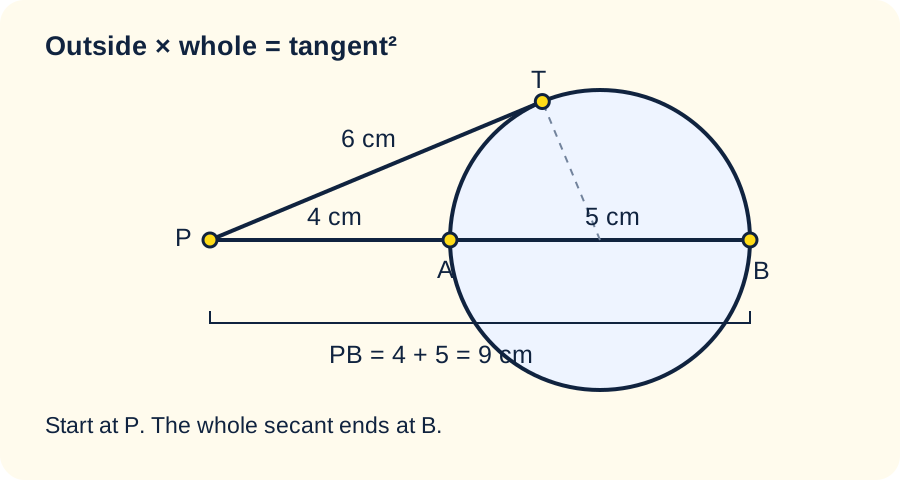
Choose the rule: a tangent and a secant start at the same outside point, so use tangent² = outside × whole.
The whole secant length is PB = PA + AB = 4 + 5 = 9 cm. Therefore:
Check: a length is positive, so take the positive square root. The common wrong calculation is 4 × 5: that multiplies outside by inside. The theorem needs the whole segment from P to the far intersection B.
Worked example 7: two secants from an external point
Problem: Two secants start at P. The first has outside length 3 cm and inside length 9 cm. The second has outside length 4 cm and inside length x cm. Find x.
The whole lengths are 12 and 4 + x. Use outside × whole on each secant:
Then 36 = 16 + 4x, so x = 5 cm.
Check: 3 × 12 = 4 × 9 = 36. The answer requested the inside piece, 5 cm; the second whole secant is 9 cm. Labeling the unknown before calculating saves this last-step mix-up.
Worked example 8: arc angles inside and outside a circle
Inside: Two chords intersect at X. The arcs intercepted by ∠AXB and its vertical angle measure 110° and 50°. Find ∠AXB.
Outside: Two secants meet at P outside a different circle. Their far intercepted arc measures 150° and their near intercepted arc measures 70°. Find the angle at P.
The useful memory aid is inside: add; outside: subtract. It applies to these intersecting-line angle configurations, not to every circle problem. Check the vertex location before reaching for it.
A circle-problem checklist
- Decide whether the unknown is an angle or a length, then mark the relevant centre and radii.
- Highlight any diameter, chord or tangent.
- Identify which two endpoints define the relevant arc.
- For angles, locate the vertex and intercepted arcs. For lengths, label outside, inside and whole segments.
- Write the theorem in words before writing an equation.
- Use ordinary angle facts—straight lines, triangles and isosceles triangles—to finish.
Many longer proofs combine circle theorems with the same statement-and-reason habits used in triangle congruence proofs. If your problem starts as a photo or screenshot, SolveTap's geometry solver from picture can help identify the marked relationships before you calculate.
Common mistakes
Using the wrong arc
Two angles may share one endpoint without standing on the same arc. Check that both pairs of rays meet the same two points on the circle.
Assuming every four-sided shape is cyclic
The opposite-angle rule requires all four vertices to lie on a circle. A general quadrilateral does not have supplementary opposite angles.
Treating a chord as a diameter
Every diameter is a chord, but not every chord passes through the centre. The semicircle theorem applies only when the chord is a diameter.
Forgetting the point of contact
A radius is perpendicular to a tangent only at the exact point where the tangent touches the circle.
Mixing up double and half
For the same arc, the central angle is twice the inscribed angle. Ask which angle is at the centre before multiplying or dividing.
Practice: choose a rule before calculating
- An inscribed angle intercepts an arc measuring 146°. Find the angle.
- A cyclic quadrilateral has an interior angle of 103°. Find its opposite angle.
- Intersecting chords have pieces 2 and 12 on one chord, and 3 and x on the other. Find x.
- A tangent and secant start at P. The secant's outside piece is 5 and its inside piece is 15. Find the tangent length.
- Two secants meet outside a circle and intercept arcs of 170° and 54°. Find the exterior angle.
Show answers with the theorem used
- 73°: an inscribed angle is half its intercepted arc, so 146 ÷ 2 = 73.
- 77°: opposite angles total 180°, so 180 − 103 = 77.
- 8: intersecting chords give 2 × 12 = 3x.
- 10: tangent² = 5 × (5 + 15) = 100. Take the positive square root.
- 58°: half the difference of the arcs is (170 − 54) ÷ 2.
To practice writing the reasons behind these steps, see our geometry proofs guide. For circles or lines described by ordered pairs, start with coordinate geometry problems.
Frequently asked questions
Is the inscribed angle theorem the same as the angle-at-the-centre theorem?
They describe the same relationship: a central angle is twice an inscribed angle intercepting the same arc. The terminology differs across curricula.
Why is an angle in a semicircle always 90 degrees?
The diameter creates a central angle of . An inscribed angle standing on that same arc is half the central angle, so it equals .
How do I know whether a quadrilateral is cyclic?
The diagram or problem may state that all four vertices lie on a circle. You can also prove a quadrilateral is cyclic if a pair of opposite angles sums to , or if an exterior angle equals the opposite interior angle.
Do circle theorems work in a circle of any size?
Yes. They depend on angle and incidence relationships, not the radius. Scaling the entire diagram changes lengths but preserves the relevant angles.
What is the difference between a chord and a secant?
A chord is the segment between two points on the circle. A secant is the entire line through two such points. In secant-length problems, “whole” means the segment from the external point to the farther intersection, not the infinite line.
When do I add arcs and when do I subtract them?
For two chords intersecting inside a circle, use half the sum of the opposite intercepted arcs. For secants or tangents meeting outside, use half the difference of the intercepted arcs. An inscribed angle uses half of one intercepted arc.
Further reading
Math Is Fun’s circle theorems provides visual explanations of the angle relationships. Its intersecting secants lesson explores exterior angles.