Coordinate geometry uses numbers to describe points, lines and shapes. Choose slope for direction, distance for length, midpoint for a halfway point, and simultaneous equations for an intersection. To prove a shape, first choose the property you need to establish, then calculate the evidence.
The formulas are a small toolbox. You do not have to empty the entire toolbox onto every question. If a problem asks for a midpoint, the distance formula can enjoy its day off.
This guide covers line equations, distances, midpoints, slopes, intersections and coordinate proofs, with worked examples and practice answers.
Which coordinate geometry formula should I use?
For two points and :
| The question asks for… | Use… | What the answer means |
|---|---|---|
| Slope or gradient | Vertical change per unit of horizontal change; requires different x-coordinates | |
| Distance | A nonnegative length | |
| Midpoint | An ordered pair halfway between the points | |
| A line through a point with known slope | An equation describing every point on the nonvertical line | |
| Where two lines meet | Solve their equations together | A point satisfying both equations, if a unique intersection exists |
| Parallel sides | Compare slopes, treating vertical lines separately | Same direction on distinct lines |
| Perpendicular sides | Check , when both slopes exist | A right angle; horizontal and vertical lines are a separate case |
| Diagonals that bisect each other | Compare their midpoints | Both diagonals share the same halfway point |
Quick translation: “equidistant” suggests distances; “bisects” suggests a midpoint; “parallel” suggests slopes. Start with the word that describes the geometric property.
Example 1: find slope and the equation of a line
Problem: Find the line through A(−2, 1) and B(4, 5).
First calculate the slope, keeping subtraction in the same order above and below:
Use point-slope form with A:
Expand and rearrange:
Answer: , or equivalently .
Check both points: when x = −2, y = 1; when x = 4, y = 5. Checking only one point could miss a wrong slope.
What if the line is vertical or horizontal?
Through (3, −1) and (3, 6), the x-coordinate never changes. The line is x = 3, and its slope is undefined. Do not divide by zero or force it into y = mx + b.
Through (−2, 4) and (5, 4), the y-coordinate stays fixed. The line is y = 4, with slope 0. Horizontal and vertical lines are perpendicular to each other even though their slopes cannot be multiplied to get −1.
Example 2: distance and midpoint from the same points
Problem: A is (−3, 2) and B is (5, −4). Find AB and its midpoint M.
The coordinate changes are 8 horizontally and −6 vertically. Distance uses those changes:
The midpoint averages the coordinates:
Answer: AB = 10 units and M = (1, −1).
Check: A to M changes by (4, −3), and M to B changes by the same amount. Each half has length 5. Notice that distance is a number, while midpoint is a point; they cannot be swapped.
Find a missing endpoint from a midpoint
If A = (−3, 2) and M = (1, −1), the other endpoint is:
You can derive this by rearranging the midpoint formula. No extra formula to memorize if your brain's storage is already full.
Example 3: find the intersection of two lines
Problem: Find where y = 2x + 1 and y = −x + 7 meet.
At the intersection, both expressions describe the same y-coordinate:
Substitute x = 2 into either original equation:
Answer: (2, 5). The other equation gives −2 + 7 = 5, which confirms it.
Two lines do not always have one intersection. Distinct parallel lines have none. Two equations describing the same line have infinitely many shared points. If one line is x = 3, substitute 3 into the other line's equation directly.
How to prove a quadrilateral using coordinates
Assume four distinct vertices form a simple, nondegenerate quadrilateral, named in order around its boundary. Connect A to B to C to D to A. Crossing the sides accidentally changes the figure you are discussing.
| Shape to prove | One sufficient route | Coordinate evidence |
|---|---|---|
| Parallelogram | Both pairs of opposite sides are parallel | Compare opposite-side slopes, with vertical cases handled separately |
| Parallelogram | Diagonals bisect each other | Both diagonal midpoints are equal |
| Rectangle | Parallelogram with one right angle | Opposite sides parallel, then adjacent sides perpendicular |
| Rectangle | Parallelogram with equal diagonals | Equal diagonal midpoints and equal diagonal lengths |
| Rhombus | All four sides have equal length | Compare the four squared side lengths |
| Square | Rectangle with equal adjacent sides | Establish the rectangle, then compare two adjacent lengths |
The table gives sufficient routes, not every possible proof. A square also counts as a rectangle and a rhombus. If the question asks for the most specific name, keep checking after you establish a broader category.
Example 4: prove a tilted rectangle using slopes
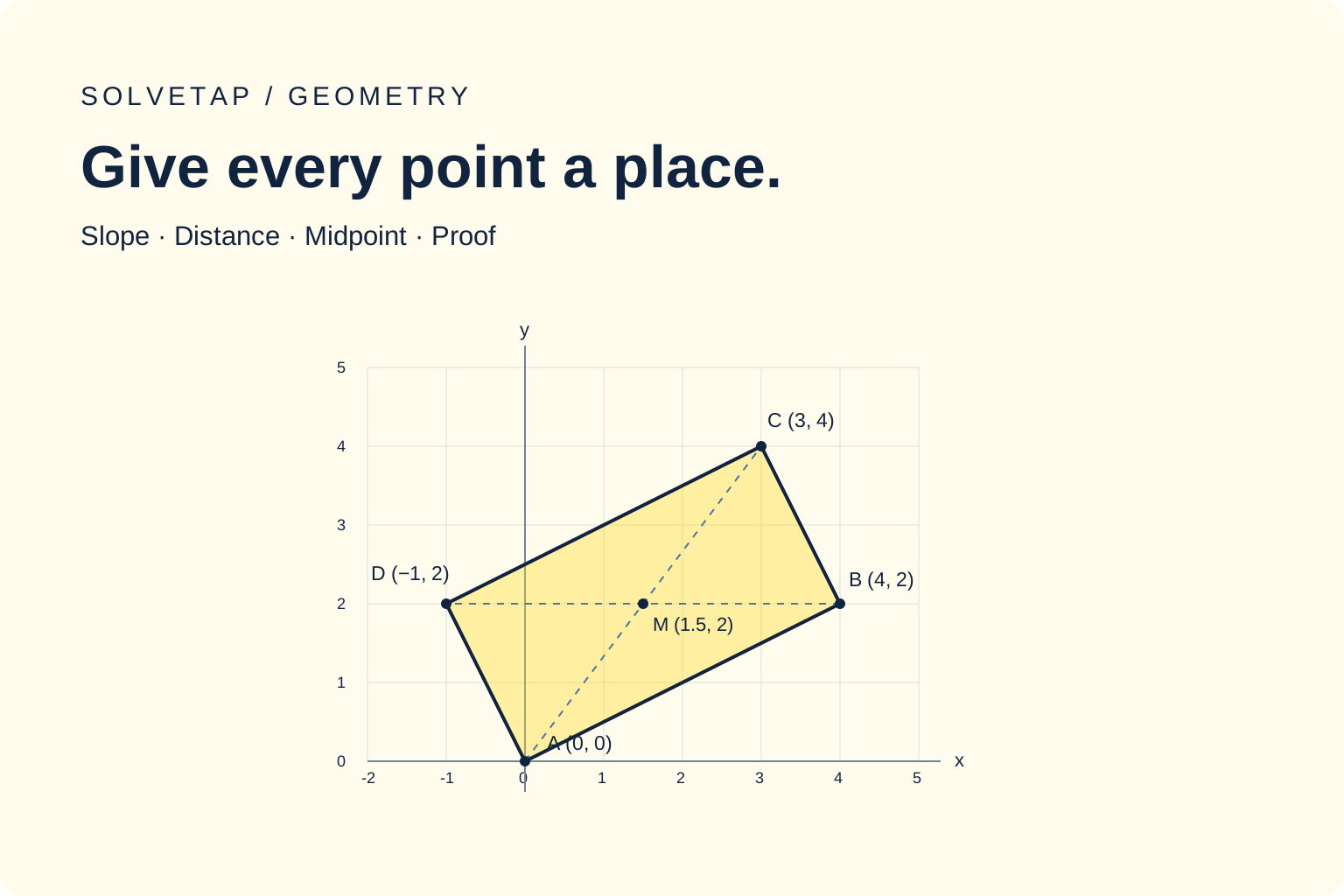
Problem: Show that A(0, 0), B(4, 2), C(3, 4) and D(−1, 2), in that order, form a rectangle.
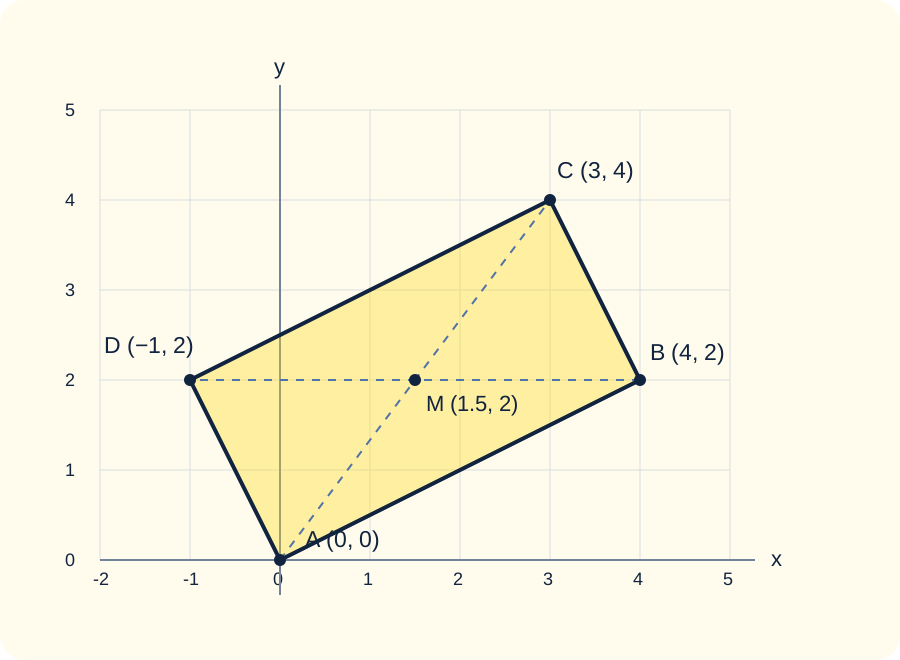
Calculate opposite-side slopes:
Therefore AB ∥ CD and BC ∥ DA, so ABCD is a parallelogram. Adjacent slopes multiply to , so AB ⟂ BC.
Conclusion: ABCD is a rectangle because it is a parallelogram with a right angle. Its tilt on the page does not matter; rectangles are allowed to lean.
It is not a square: AB² = 4² + 2² = 20, whereas BC² = (−1)² + 2² = 5, so adjacent sides have different lengths.
An alternative proof using diagonals
Both AC and BD have midpoint (1.5, 2), so the diagonals bisect each other and ABCD is a parallelogram. Their squared lengths are:
The diagonals are equal, so this parallelogram is a rectangle. Equal diagonals alone are not enough: an isosceles trapezoid can have equal diagonals without being a rectangle.
Example 5: prove a rhombus without calculating square roots
Problem: Classify A(0, 0), B(3, 2), C(6, 0) and D(3, −2).
Each side has squared length 13:
Conclusion: all four sides are equal, so ABCD is a rhombus. Comparing squared lengths is enough because lengths are nonnegative.
Is it also a square? The adjacent slopes are 2/3 and −2/3, whose product is −4/9, not −1. There is no right angle at B, so it is a rhombus, but not a square.
Its diagonals are horizontal and vertical, hence perpendicular. However, perpendicular diagonals by themselves would not prove a rhombus: some kites have them too.
Common coordinate geometry mistakes
- Changing subtraction order halfway through. Use B minus A for both coordinates, or A minus B for both.
- Losing a negative sign. Write 5 − (−3), then simplify it to 8.
- Calling undefined slope zero. Vertical slope is undefined; horizontal slope is zero.
- Taking unnecessary square roots. To compare lengths, compare squared lengths and keep exact values.
- Stopping at the arithmetic. “Both midpoints are (1.5, 2)” is evidence. Add “so the diagonals bisect each other, which proves a parallelogram.”
- Assuming the picture proves the shape. A neat-looking right angle needs a slope calculation or another valid reason.
For proofs built from diagram markings instead of coordinates, use geometry proofs step by step. For angle and segment relationships on circles, try circle theorem problems.
Practice problems with answers
- Find the slope and equation of the line through (1, 3) and (5, 11).
- Find the midpoint and distance between (−2, −1) and (4, 7).
- Find the intersection of y = 3x − 2 and y = x + 4.
- Classify A(0, 0), B(2, 2), C(4, 0) and D(2, −2) as specifically as possible. Give a reason.
Show answers and reasoning
- Slope 2; y = 2x + 1. The slope is (11 − 3)/(5 − 1) = 2. Substitute (1, 3) to get the intercept 1.
- Midpoint (1, 3); distance 10. Average the coordinates. For distance, the changes are 6 and 8, whose squared sum is 100.
- (3, 7). Set 3x − 2 = x + 4, giving x = 3. Substitution gives y = 7.
- Square. Every squared side length is 8; opposite slopes match and adjacent slopes are 1 and −1. Thus it has four equal sides and right angles.
Frequently asked questions
When should I use slope, distance or midpoint in a proof?
Use slope to establish parallel or perpendicular directions, distance to establish equal lengths, and midpoint to establish that a point bisects a segment. Equal diagonal midpoints can establish a parallelogram.
Can two lines have the same slope and still intersect?
Distinct lines with the same defined slope are parallel and do not intersect. If they also share a point, they are the same line, with infinitely many common points.
Does equal midpoint mean a quadrilateral is a rectangle?
If the two diagonals of a simple quadrilateral have the same midpoint, they bisect each other, establishing a parallelogram. To prove a rectangle, also establish a right angle or equal diagonals.
Can I use a graph instead of showing calculations?
A graph helps you see which properties to check, but a coordinate proof needs exact evidence and a concluding reason. Use the picture to plan the proof, then let the numbers establish it.
If you want help checking a worksheet, try the Geometry Solver. Confirm that it reads every negative sign and coordinate correctly, then compare its reasoning with your own steps.
Further reading
MathBitsNotebook’s coordinate proof lesson offers additional practice connecting calculations to geometric conclusions.