A geometry proof explains why a statement must be true, using given facts, definitions and theorems. To start, write what you know, identify what you need to prove, and find the rule that connects them. Triangle congruence, similarity, parallel lines and circle theorems give you several useful routes.
If you have ever stared at a triangle hoping it would explain itself, welcome. The trick is to give each step a reason. Think of the reason column as your math teacher asking, “Okay, but how do you know?”
For triangle congruence, the reliable method is to mark the givens, find one of the five valid congruence criteria, and write every statement with its reason. Once the triangles are congruent, you can use CPCTC to prove that any remaining pair of corresponding sides or angles is congruent.
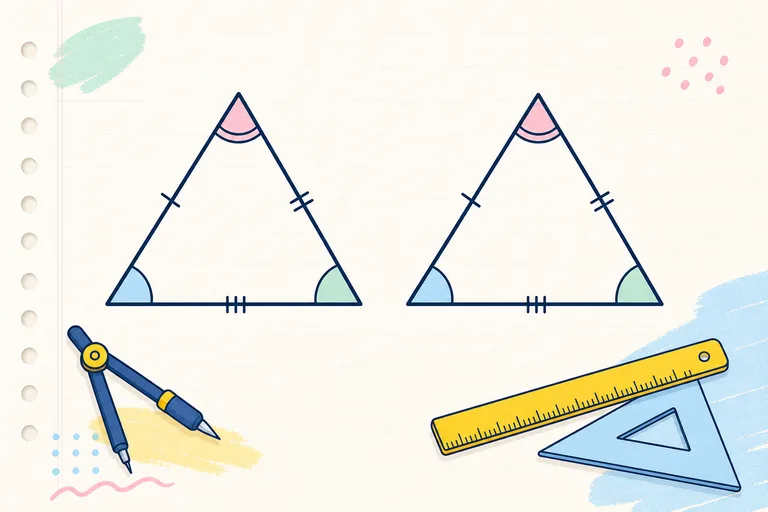
Triangle congruence in one sentence: identify three matching facts, check that they form SSS, SAS, ASA, AAS or HL, state the triangles in the correct corresponding order, and only then use CPCTC.
How do you know which theorem to use in a geometry proof?
Start with the goal, then look for the facts that would establish it. You can plan backward, but write the finished proof forward so that each step uses facts already established.
| What you need to prove | Look for | Useful route |
|---|---|---|
| Two triangles have the same size and shape | Matching side and angle facts | SSS, SAS, ASA, AAS or HL congruence |
| Two triangles have the same shape | Two equal angle pairs or proportional sides | AA, SAS or SSS similarity |
| Two lines are parallel | Equal corresponding or alternate interior angles | Converse of the relevant parallel-line theorem |
| Two sides or angles match | Triangles containing those parts | Prove congruence, then use CPCTC |
| Two tangent segments are equal | Radii to the points of tangency | Build right triangles and use HL |
When the diagram has no congruence marks: translate the words first. “M is the midpoint” gives two equal segments. A shared side gives a reflexive fact. Intersecting lines give vertical angles. If the information still does not support a theorem, do not invent a missing fact. Some questions really do have the answer “not enough information.”
The five valid triangle congruence theorems
| Theorem | What you must know | Detail that matters |
|---|---|---|
| SSS | Three pairs of corresponding sides | All three side pairs must match. |
| SAS | Two side pairs and the included angle | The angle must sit between the two known sides. |
| ASA | Two angle pairs and the included side | The known side sits between the two angles. |
| AAS | Two angle pairs and a non-included side | The known side is not between the two angles. |
| HL | Hypotenuse and one leg of right triangles | Both triangles must first be known to be right triangles. |
“Included” simply means “in the middle.” In SAS, the known angle touches both known sides. In ASA, the known side connects the vertices of the two known angles.
Two tempting shortcuts do not prove congruence:
- SSA is not generally valid. Two sides and a non-included angle can sometimes produce two different triangles. This is the ambiguous case.
- AAA proves similarity, not congruence. Equal angles fix the shape, but one triangle can still be a scaled version of the other.
A repeatable proof-writing process
1. Mark every given fact
Translate the words into diagram marks. Equal sides get matching tick marks. Equal angles get matching arcs. Parallel lines get arrow marks, and right angles get a small square.
Do not trust how a sketch looks. A side that appears longer is not longer unless the problem states or marks that relationship.
2. Add facts implied by the diagram
Many proofs depend on one fact that is not written in the “given” line:
- A shared side is congruent to itself by the reflexive property.
- Vertical angles are congruent.
- A midpoint creates two congruent segments.
- An angle bisector creates two congruent angles.
- Perpendicular lines create right angles, and all right angles are congruent.
- Parallel lines create congruent alternate interior or corresponding angles.
3. Match the facts to a valid theorem
Count the side and angle relationships. Then check their positions. “Two sides and an angle” is not automatically SAS; the angle must be included. “Two angles and a side” may be ASA or AAS depending on the side’s location.
4. Write corresponding vertices in the same order
If vertex A matches D, B matches E and C matches F, write:
△ABC ≅ △DEF
Changing the order can make an otherwise correct proof incorrect because the congruence statement itself claims which parts correspond.
5. Use CPCTC only after congruence is established
CPCTC means corresponding parts of congruent triangles are congruent. It is a consequence of triangle congruence, not a way to prove triangle congruence. First state the valid theorem; then use CPCTC to reach the final side or angle claim.
Worked example 1: an SSS proof with a shared side
Given: In quadrilateral ABCD, AB ≅ CD and BC ≅ DA. Diagonal AC is drawn.
Prove: △ABC ≅ △CDA.
| Statement | Reason |
|---|---|
| AB ≅ CD | Given |
| BC ≅ DA | Given |
| AC ≅ CA | Reflexive property |
| △ABC ≅ △CDA | SSS congruence theorem |
The first two side pairs come directly from the givens. The diagonal is the same physical segment in both triangles, so it supplies the third pair.
Check the order: AB corresponds to CD, BC corresponds to DA, and AC corresponds to CA. Therefore A ↔ C, B ↔ D and C ↔ A, which makes △ABC ≅ △CDA the correct statement.
Worked example 2: a SAS proof using vertical angles
Segments AC and BD intersect at E.
Given: AE ≅ CE and BE ≅ DE.
Prove: △AEB ≅ △CED.
| Statement | Reason |
|---|---|
| AE ≅ CE | Given |
| ∠AEB ≅ ∠CED | Vertical angles are congruent |
| BE ≅ DE | Given |
| △AEB ≅ △CED | SAS congruence theorem |
The angle at E is included: ∠AEB lies between AE and BE, while ∠CED lies between CE and DE. That positional check is what makes the theorem SAS rather than the invalid SSA pattern.
If the problem next asked you to prove AB ≅ CD, you could add:
| Statement | Reason |
|---|---|
| AB ≅ CD | CPCTC |
CPCTC is valid now because the preceding line already established that the triangles are congruent.
Worked example 3: an ASA proof from parallel lines
Suppose opposite sides of quadrilateral ABCD are parallel: AB ∥ CD and BC ∥ AD. Draw diagonal AC.
Prove: △BAC ≅ △DCA.
| Statement | Reason |
|---|---|
| ∠BAC ≅ ∠DCA | Alternate interior angles; AB ∥ CD |
| AC ≅ CA | Reflexive property |
| ∠BCA ≅ ∠DAC | Alternate interior angles; BC ∥ AD |
| △BAC ≅ △DCA | ASA congruence theorem |
The shared side AC sits between the two known angles in each triangle, so ASA is the precise theorem. If the known side had not been between the two angle pairs, the criterion would have been AAS.
Worked example 4: prove similar triangles using parallel lines
Given: D lies inside side AB, E lies inside side AC, and DE ∥ BC in triangle ABC.
Prove: △ADE ∼ △ABC. Then find AE if AD = 4, AB = 10 and AC = 15.
| Statement | Reason |
|---|---|
| ∠DAE ≅ ∠BAC | Same angle at A; AD and AB lie on the same ray, as do AE and AC |
| ∠ADE ≅ ∠ABC | Corresponding angles; DE ∥ BC |
| △ADE ∼ △ABC | AA similarity |
The vertex order tells us AD corresponds to AB and AE corresponds to AC. Therefore:
Check: the smaller triangle has scale factor 0.4, so its corresponding side is 40% of 15. The result fits.
AA proves similarity because matching angles fix the shape. Congruence also requires the size to match. A photocopier set to 200% is an excellent way to remember the difference.
For SAS similarity, two pairs of corresponding sides must be proportional and their included angles equal. For SSS similarity, all three corresponding side ratios must match. Similarity uses ratios; congruence uses equal lengths.
Worked example 5: prove lines parallel from angle information
Given: A transversal crosses distinct coplanar lines l and m. One pair of alternate interior angles measures 68° and 68°.
Prove: l ∥ m.
| Statement | Reason | | The alternate interior angles have equal measures | Both are 68°, given | | The alternate interior angles are congruent | Definition of congruent angles | | l ∥ m | Converse of the alternate interior angles theorem |
Notice the direction. Parallel lines give equal angles is the theorem. Equal alternate interior angles give parallel lines is its converse. Using “the lines are parallel” as a reason here would assume the very thing we are proving.
The same idea works with congruent corresponding angles, or with same-side interior angles whose measures add to 180°, using the appropriate converse.
Worked example 6: a circle proof with equal tangents
Given: PA and PB are tangent segments from an external point P to a circle with center O. A and B are the points of tangency.
Prove: PA ≅ PB.
Draw OA, OB and OP. The radii create two right triangles.
| Statement | Reason | | OA ⟂ PA and OB ⟂ PB | A radius is perpendicular to a tangent at the point of tangency | | △OAP and △OBP are right triangles | Definition of a right triangle | | OA ≅ OB | Radii of the same circle | | OP ≅ OP | Reflexive property | | △OAP ≅ △OBP | HL: common hypotenuse OP and equal legs OA, OB | | PA ≅ PB | CPCTC |
That is why tangent segments from the same external point have equal lengths. We did not use the equal-tangents theorem to prove itself; we built the result from radii, right angles and congruence.
For finding actual angles and lengths, continue with these circle theorem problems. If your givens are ordered pairs, use the coordinate geometry guide.
ASA versus AAS: the common mix-up
Circle the two known angles in one triangle. Now trace the side connecting their vertices:
- If that connecting side is the side you know, use ASA.
- If the side you know is one of the other two sides, use AAS.
Both theorems prove congruence, so confusing their names may look like a small error. In a formal proof, however, the reason must match the facts you actually established.
How HL works for right triangles
HL is a specialized theorem. You need four ingredients:
- Both figures are triangles.
- Both are right triangles.
- Their hypotenuses are congruent.
- One pair of corresponding legs is congruent.
Do not use HL for general triangles, and do not assume a triangle is right because it looks right. The right angle must be given or proven.
Common proof mistakes
Using a fact before proving it
If the diagram shows a midpoint, state that the midpoint divides a segment into two congruent parts before using those parts in SSS or SAS.
Treating the diagram as evidence
Visual appearance is never a proof reason. Replace “they look equal” with a given, definition, postulate or theorem.
Writing the triangles out of order
After you choose a starting vertex in the first triangle, move around both triangles in corresponding directions. Confirm that every pair in the congruence statement matches your marked sides and angles.
Invoking CPCTC too early
CPCTC cannot be one of the facts used to establish the original congruence. It becomes available on the line after the congruence theorem.
Forgetting the reason column
A list of true statements is not yet a proof. The reason column explains why each move is allowed and makes the argument checkable.
A final checklist
Before submitting a triangle proof, ask:
- Did I use only facts that were given or proven?
- Do my three facts form SSS, SAS, ASA, AAS or HL?
- If I used SAS or ASA, is the part truly included?
- Are corresponding vertices in the same order?
- Did I wait until after congruence to use CPCTC?
- Does every statement have a specific reason?
If you are working from a photographed worksheet or textbook diagram, the free geometry solver from a picture can restate the givens and explain each proof line. Use it to check your reasoning, then try a similar proof without assistance.
For numerical right-triangle questions rather than proofs, use the same diagram-first habit in these Pythagorean theorem word problems: mark the right angle, identify the hypotenuse, and only then choose the equation.
Try three proof questions yourself
- △ABC and △DEF have AB = DE, AC = DF and ∠A = ∠D. Which congruence theorem applies?
- Two triangles have angles of 45°, 65° and 70°. Must they be congruent?
- A transversal makes same-side interior angles of 112° and 68° with two distinct coplanar lines. What can you prove?
Show answers and reasons
- SAS. The equal angle lies between the two equal side pairs.
- No. They are similar by AA, but their sizes could differ.
- The lines are parallel. The angles total 180°, so the converse of the same-side interior angles theorem applies.
Frequently asked questions
Is SSA ever a valid congruence theorem?
Not in general. The same two sides and non-included angle can describe two different triangles. A special right-triangle situation may be handled by HL, but that works because the right angle and hypotenuse remove the ambiguity.
Does AAA prove that two triangles are congruent?
No. AAA proves that the triangles are similar. Their corresponding angles match, but their corresponding side lengths may differ by a scale factor.
Can I use the reflexive property in every proof?
Only when the two triangles genuinely share a side or angle. A shared side is congruent to itself, but separate segments do not become congruent merely because they look alike.
What is the difference between a theorem and CPCTC?
SSS, SAS, ASA, AAS and HL establish that the complete triangles are congruent. CPCTC then lets you conclude that a remaining pair of corresponding sides or angles is congruent.
Further reading
See Khan Academy’s triangle congruence review for another explanation of congruence criteria, or Math Is Fun’s congruence guide for visual comparisons.