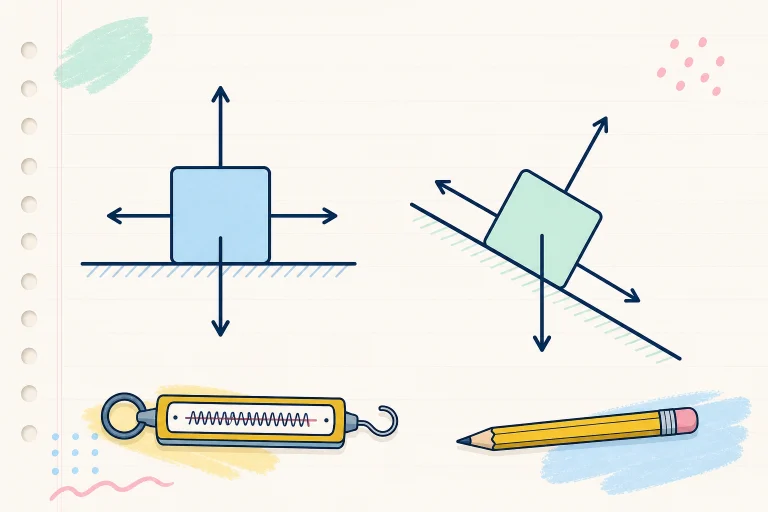
A free-body diagram is a picture of one chosen object and every external force acting on it. It turns a physical scene into the force equations needed for equilibrium or .
The drawing does not need to look realistic. Replace the object with a box or dot, draw each force as an arrow beginning on that object, and label the arrow. What matters is the direction and meaning of every force.
The boundary test: if you isolated the object from its surroundings, which pushes or pulls from the surroundings would still act on it? Those interactions belong on its free-body diagram.
What a free-body diagram shows—and what it does not
A correct diagram shows external forces acting on the selected object. Common forces include:
| Force | Typical symbol | Direction |
|---|---|---|
| Weight | or | Vertically downward, toward Earth's centre |
| Normal force | Perpendicular to the contact surface, away from it | |
| Friction | Along the surface, opposing actual or impending relative motion | |
| Tension | Along a rope or cable, pulling away from the object | |
| Applied force | In the direction of the push or pull | |
| Drag | Opposite the object's motion through a fluid |
The diagram should not include velocity arrows, acceleration arrows or the object's path as if they were forces. It should also omit forces that the chosen object exerts on something else. Newton's third-law partner forces act on different objects and therefore appear on different diagrams.
How to draw a free-body diagram in six steps
- Choose the object. Write its name before drawing anything.
- Replace it with a simple shape. A dot or rectangle is enough.
- List the interactions. Ask what touches the object and whether gravity, electric or magnetic forces act at a distance.
- Draw one arrow per force. Start each arrow on the object and point it in the force direction.
- Label every arrow by force type. Avoid vague labels such as “push” when , or is more precise.
- Choose axes and write component equations. On an incline, axes parallel and perpendicular to the surface usually simplify the algebra.
Arrow lengths may represent relative magnitudes when those magnitudes are known. Do not make opposite arrows equal merely because the object looks stationary; justify equality from zero acceleration.
Worked example 1: book resting on a table
Problem: A book rests on a horizontal table. Draw its free-body diagram and find the normal force. Use .
Step 1: choose the object and interactions
The object is the book. Earth pulls it downward through gravity, and the table pushes it upward through the normal force.
The free-body diagram has exactly two arrows:
- Weight downward.
- Normal force upward.
There is no horizontal force because no horizontal interaction is described. “The book pushes down on the table” is not another force on the book; it acts on the table.
Step 2: calculate the weight
Step 3: apply vertical equilibrium
The book is at rest, so . Taking upward as positive:
Answer: The diagram contains upward and downward, each with magnitude .
The normal force equals the weight here because these are the only vertical forces and the vertical acceleration is zero. It is not a universal rule.
Worked example 2: block on a frictionless incline
Problem: A block is released on a frictionless incline. Draw its free-body diagram, then find the normal force and acceleration down the slope.
Step 1: identify the forces
Only two forces act on the block:
- Weight , vertically downward.
- Normal force , perpendicular to the incline.
There is no friction arrow because the surface is explicitly frictionless. The component is not a third force; it is part of the weight resolved along the chosen axis.
Step 2: choose rotated axes
Let the x-axis point down the incline and the y-axis point outward, perpendicular to the incline. Resolve the weight:
- Parallel component: , down the slope.
- Perpendicular component: , into the slope.
The total weight is:
Step 3: solve perpendicular to the surface
The block does not accelerate through the incline, so :
Step 4: solve parallel to the surface
Cancel the mass:
Answer: The normal force is , and the block accelerates down the incline at .
Notice that . The surface balances only the component of weight perpendicular to it.
Worked example 3: lamp supported by two ropes
Problem: A lamp hangs at rest from two identical ropes. Each rope makes a angle above the horizontal. Find the tension in each rope.
Step 1: draw the forces on the lamp
The free-body diagram contains three arrows:
- Weight vertically downward.
- Left-rope tension , directed up and left along the rope.
- Right-rope tension , directed up and right along the rope.
Because the setup is symmetric, the horizontal tension components cancel. The two vertical components support the weight.
Step 2: calculate the weight
Step 3: apply vertical equilibrium
Each rope contributes an upward component :
Answer: The tension in each rope is approximately .
If the angle were measured from the vertical instead, the vertical component would use cosine. Sketching the component triangle beside the force arrow prevents that sine-versus-cosine mix-up.
Turning the diagram into equations
Once the diagram is complete, each axis gets one Newton's-second-law equation:
An equilibrium problem is not a different law; it is the special case in which acceleration is zero. For moving objects, the net force points in the acceleration direction, not necessarily the velocity direction.
Free-body diagrams are the setup step for nearly every forces problem. SolveTap's physics problem solver can interpret a photographed question and separate the forces before applying equations. The same component discipline also helps in projectile motion problems, where horizontal and vertical quantities must remain separate.
Common free-body diagram mistakes
Drawing forces the object exerts
If a book pushes on a table, that force belongs on the table's diagram. The table's normal force on the book belongs on the book's diagram.
Drawing components as extra forces
After resolving weight into and , do not also include the original arrow in the component equations. Use either the vector or its components, not both.
Always setting the normal force equal to weight
The normal force changes on inclines and when other vertical forces act. Calculate it from the equation perpendicular to the surface.
Pointing friction opposite velocity automatically
Friction opposes relative slipping or the tendency to slip between surfaces. A driven wheel, for example, can experience forward static friction.
Drawing tension toward the object
A rope pulls; it does not push. The tension arrow on an object points away from the object along the rope.
Adding a “force of motion”
Motion is not a force. An object can move at constant velocity while the net force is zero.
Frequently asked questions
Does every object have a normal force?
No. A normal force exists only when an object contacts a surface. A falling object that is no longer touching a surface has no normal force.
Should arrow length show force magnitude?
When relative magnitudes are known, proportional arrows make the diagram easier to read. If magnitudes are unknown, clearly labeled direction arrows are sufficient.
Is centripetal force an extra force?
“Centripetal force” describes the net inward force required for circular motion. It is supplied by real forces such as tension, gravity, friction or a normal force; do not automatically add a separate centripetal-force arrow.
Why rotate the axes on an incline?
Axes parallel and perpendicular to the surface align with the acceleration and normal force. This usually leaves only weight to resolve into components and makes the equations shorter.