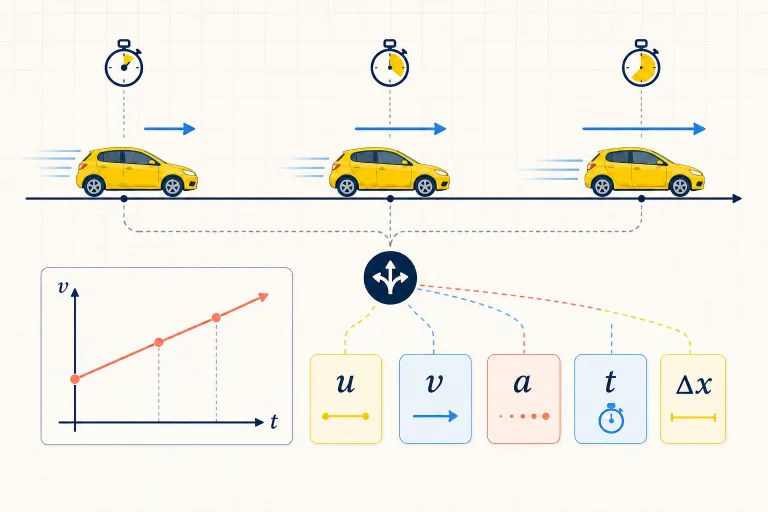
The fastest way to choose a kinematics equation is to list five variables—initial velocity, final velocity, acceleration, time and displacement—then select the equation that does not contain the variable you neither know nor need.
That method works for one-dimensional motion with constant acceleration. It is more reliable than matching a problem to a memorized example because it turns equation choice into a short elimination process.
The five kinematics variables
This guide uses the following symbols:
| Symbol | Meaning | SI unit |
|---|---|---|
| initial velocity | ||
| final velocity | ||
| constant acceleration | ||
| elapsed time | ||
| displacement, or |
Some textbooks write instead of and instead of . The physics is identical.
The constant-acceleration restriction matters. OpenStax’s high-school physics text states that these kinematic equations describe motion with constant acceleration and recommends listing knowns and unknowns before choosing an equation.
The four equations and the variable each omits
| Equation | Variable omitted | Best clue |
|---|---|---|
| displacement is not given or needed | ||
| final velocity is not given or needed | ||
| time is not given or needed | ||
| acceleration is not given or needed |
The last equation uses average velocity, , which equals the arithmetic mean of the initial and final velocities only when acceleration is constant.
Different courses count the equations differently because they may include definitions or position formulas separately. Do not worry about whether your sheet says three, four or five equations. Compare the variables in the equation with the quantities in the problem.
A decision guide for choosing the equation
- Choose a positive direction. Right or upward is common, but consistency matters more than the choice.
- Translate words into variables. “Starts from rest” means . “Stops” means .
- List the known values with signs and units. Do not substitute yet.
- Circle the target. Identify exactly one value the question asks you to find.
- Cross out the unwanted variable. It is neither known nor requested.
- Pick the equation that omits it. The remaining equation should contain the target and known values only.
For example, if a braking problem gives , and and asks for , time is the unwanted variable. Use because it omits .
If no equation contains only one unknown, you may need two equations in sequence. That is normal. OpenStax University Physics notes that problems with two unknowns require enough independent equations to solve both.
Worked example 1: final speed after accelerating
Problem: A cyclist travels at and accelerates uniformly at for . Find the final velocity.
List the variables:
- target:
- unwanted variable:
Choose the equation that omits displacement:
Substitute:
Answer: The final velocity is in the positive direction.
Check: positive acceleration acts in the direction of motion, so the final speed should be greater than the initial speed.
Worked example 2: stopping distance without time
Problem: A motorcycle travels at and brakes with constant acceleration . How far does it travel before stopping?
Choose forward as positive:
- target:
- unwanted variable:
Use the equation without time:
Solve for displacement:
Answer: The motorcycle travels approximately while braking.
Both the numerator and denominator are negative, so the displacement is positive. A negative distance here would warn you that the sign convention was applied inconsistently.
Worked example 3: runway motion needs two equations
Problem: An aircraft starts from rest and accelerates uniformly at for . Find its takeoff speed and displacement along the runway.
Known values:
First find final velocity using :
Then find displacement. Because is not required in the displacement equation, use:
Answer: The aircraft reaches after traveling .
As a cross-check, constant acceleration gives an average velocity of . Then , matching the result.
Worked example 4: vertical motion and signs
Problem: A ball is thrown straight upward at . Ignoring air resistance, how high does it rise above the release point?
Choose upward as positive. At the highest point, the ball’s velocity is momentarily zero, but gravity still accelerates it downward:
- target:
- unwanted variable:
Use the equation without time:
Answer: The ball rises approximately .
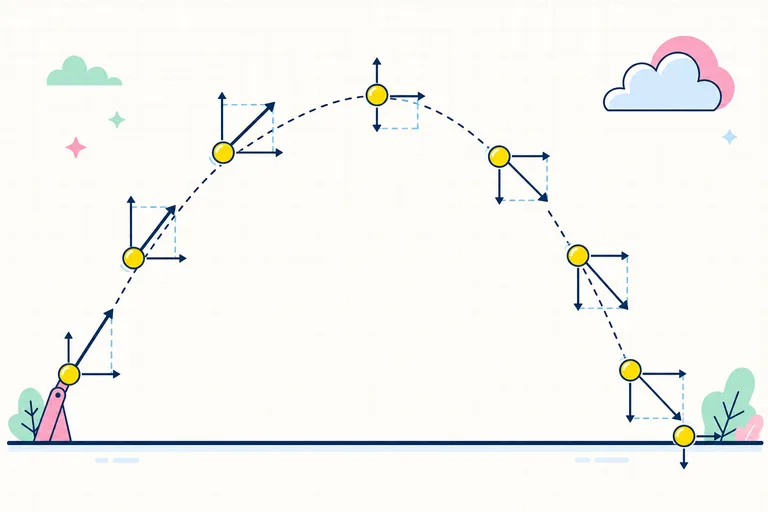
For two-dimensional launches, use the equations separately on each axis. The complete component method appears in our guide to projectile motion problems.
How word clues translate into variables
| Wording in the problem | Translation |
|---|---|
| starts from rest | |
| comes to rest or stops | |
| dropped | vertically |
| constant speed | |
| accelerates opposite the positive direction | |
| highest point of vertical motion | , but |
| returns to its starting position | for the whole trip |
“Decelerates” does not automatically mean acceleration is negative. Acceleration is negative only if it points in your chosen negative direction. An object moving left can slow down with positive acceleration.
Common kinematics mistakes
Using the equations when acceleration changes
These formulas assume constant acceleration. If acceleration varies with time, you may need graphs, calculus or a piecewise analysis.
Mixing distance and displacement
Displacement includes direction and may be zero after a round trip. Total distance cannot be negative and may be larger than the magnitude of displacement.
Losing the sign convention
Write the positive direction before assigning signs. If upward is positive, both a downward velocity and gravitational acceleration are negative.
Choosing an equation with two unknowns
An equation may contain the target but still be inefficient. Prefer the equation that contains your target, your knowns and no extra unknown.
Dropping units
Units catch errors. In , acceleration times time has units , matching velocity.
Assuming zero velocity means zero acceleration
At the top of a vertical throw, velocity is zero for an instant while acceleration remains . Velocity describes motion; acceleration describes how velocity changes.
A 20-second answer check
- Does the sign match the direction you described?
- Are the units correct for the target quantity?
- Should the object be speeding up or slowing down?
- Is a leg of the calculation based on constant acceleration?
- Does a second equation or average-velocity check reproduce the result?
If a photographed problem gives you several values and you are unsure which are relevant, SolveTap’s free physics problem solver lists the knowns and unknowns before selecting an equation. Use that selection as a check, then practice the same omit-the-unused-variable method yourself.
Frequently asked questions
What is the easiest way to remember which kinematics equation to use?
Do not memorize a separate story for each equation. Memorize which variable each equation omits, then cross out the quantity you neither know nor need.
Are SUVAT equations the same as kinematics equations?
In introductory mechanics, SUVAT commonly refers to the constant-acceleration equations using displacement , initial velocity , final velocity , acceleration and time .
Can I use kinematics equations for projectile motion?
Yes, when air resistance is ignored and acceleration is constant. Apply them separately in the horizontal and vertical directions, linked by the same time.
Why are there sometimes three equations and sometimes five?
Textbooks group average-velocity definitions and position equations differently. The useful question is not the count; it is whether the selected equation is valid for constant acceleration and connects the knowns to the target.