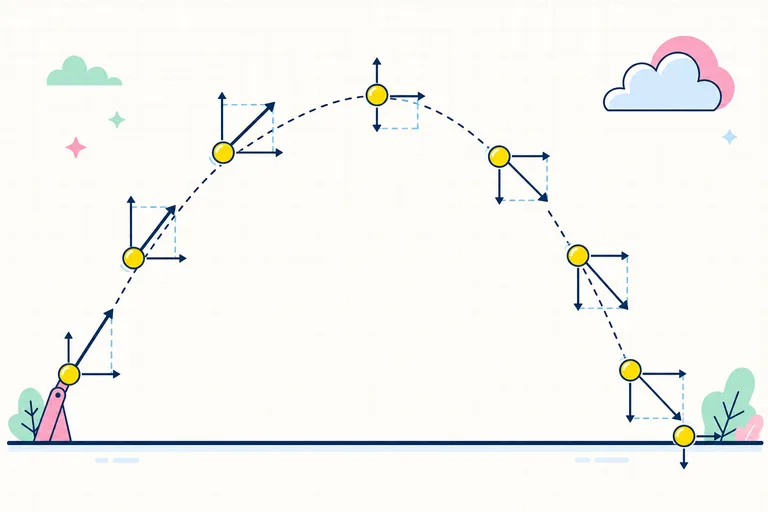
Projectile motion becomes manageable when you stop treating it as one complicated motion. It is two simpler motions happening at the same time:
- Horizontal motion: constant velocity when air resistance is ignored.
- Vertical motion: constant downward acceleration caused by gravity.
The axes share one variable—time—but their positions, velocities and accelerations are calculated separately. Most projectile mistakes come from mixing an x-value into a y-equation or using the full launch speed where a component is required.
We use downward throughout. Some courses approximate it as ; follow the value specified by your problem.
The projectile-motion setup
Choose positive x in the direction of launch and positive y upward. With that convention:
| Direction | Acceleration | Useful equation |
|---|---|---|
| Horizontal | ||
| Vertical | ||
| Vertical velocity |
For a launch speed at angle above the horizontal:
The horizontal component stays constant. The vertical component decreases on the way up, becomes zero at the highest point, and becomes negative on the way down.
A six-step method that works
- Sketch the path and choose axes. Mark the launch and landing heights.
- List the known values by direction. Keep an x-column and a y-column.
- Split an angled launch velocity into components. Do not split a purely horizontal launch; its initial vertical velocity is already zero.
- Use the vertical motion to find time. Height information usually makes the y-equation the easiest starting point.
- Use that same time horizontally. Calculate range from .
- Recombine velocity components if needed. Use the Pythagorean theorem for speed and trigonometry for direction.
Worked example 1: horizontal launch from a cliff
Problem: A ball rolls horizontally from a cliff at . Ignore air resistance. Find its time in the air, horizontal range and impact speed.
Step 1: organize the components
Horizontal values:
Vertical values, taking the launch point as :
Step 2: find time from the vertical motion
Use :
Time cannot be negative, so:
Step 3: calculate horizontal range
Step 4: calculate impact speed
The horizontal velocity remains . The final vertical velocity is:
Combine the perpendicular components:
Answer: The ball is airborne for 2.00 s, travels 24.0 m horizontally and hits at approximately 23.0 m/s.
Worked example 2: angled launch from level ground
Problem: A football is kicked at , (30.0°) above level ground. Find the time of flight, maximum height and range. Assume it lands at its launch height.
Step 1: resolve the launch velocity
Step 2: find the time to the highest point
At maximum height, :
Because the football lands at the same height and air resistance is ignored, the descent takes the same time:
Step 3: calculate maximum height
Using :
Step 4: calculate range
Answer: Time of flight is 2.04 s, maximum height is 5.10 m, and range is approximately 35.3 m.
The symmetry shortcut works only because launch and landing heights match. If they differ, solve the full vertical position equation.
Worked example 3: angled launch from a platform
Problem: A ball is launched at , (45°) above horizontal, from a platform above the ground. Find when and where it lands.
Step 1: resolve the velocity
At (45°), the components are equal:
Step 2: solve the vertical equation for time
Set ground level to , with :
Rearrange and use the quadratic formula:
The roots are approximately and . The negative root describes the mathematical continuation of the path before launch, so the physical time is:
Step 3: calculate horizontal distance
Answer: The ball lands after approximately 2.44 s, 24.2 m from the base of the platform.
Common projectile-motion mistakes
Using the launch speed in both directions
For an angled launch, is the magnitude of the velocity vector. The equations need or , found with cosine and sine.
Giving gravity the wrong sign
If up is positive, acceleration is . If down is positive, gravity is positive—but every displacement and velocity sign must follow that same choice.
Assuming the vertical velocity is zero for the whole trip
Only a horizontal launch has . For an angled projectile, only at the highest point. Gravity continues acting there.
Using symmetry when heights differ
Time up equals time down only when the projectile returns to its launch height. A cliff or platform problem requires the full vertical equation.
Rounding components too soon
Keep extra calculator digits for sine, cosine, time and velocity components. Round only the final requested values.
How to check whether an answer is reasonable
- Time should be positive.
- A horizontally launched object begins with zero vertical velocity but gains downward speed.
- Horizontal velocity should remain unchanged when drag is ignored.
- At maximum height, vertical velocity is zero but horizontal velocity is not.
- A higher launch point usually increases total time and range when the initial velocity is unchanged.
- Units must match the quantity: seconds for time, metres for displacement and metres per second for velocity.
If you want help identifying the correct equation from a screenshot, SolveTap’s free physics problem solver separates the axes and explains why each kinematics equation applies. For a reusable formula-selection method before you split motion into axes, see which kinematics equation to use. Check the setup and reasoning rather than copying only the final value.
Frequently asked questions
Why can horizontal and vertical motion be solved separately?
With air resistance ignored, gravity acts only vertically. There is no horizontal force, so horizontal acceleration is zero. Time connects the two independent directions.
Is velocity zero at the top of the path?
Only the vertical component is zero. Unless the projectile was launched straight upward, it still has horizontal velocity at the highest point.
When can I use the projectile range formula?
The common formula (R=v_0^2\sin/g) assumes the projectile lands at the same height from which it was launched and that air resistance is negligible. The component method works in more situations and makes the assumptions clearer.
Why does a quadratic equation give a negative time?
The mathematical parabola extends before the chosen launch instant. The negative root corresponds to that earlier point and is normally rejected because the physical motion begins at .