SolveTap · Learn the method
Pythagorean Theorem Calculator
Find one missing side of a right triangle and see the formula, substitution and result.
Calculate
Enter two positive side lengths in the same unit. Leave the missing side blank; c is always the hypotenuse.
Calculations run in your browser. Numeric inputs are not included in analytics events.
Formula and variables
a² + b² = c²; c = √(a² + b²); a = √(c² − b²)
a and b are perpendicular legs; c is the side opposite the right angle. Every length uses the same unit.
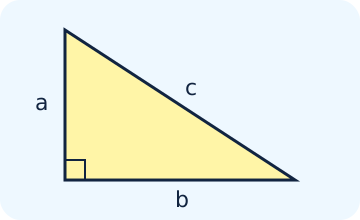
Worked example
A right triangle has legs 3 cm and 4 cm. Square the legs: 9 + 16 = 25. Take the positive square root: c = 5 cm. Check: 3² + 4² = 5².
When to use this formula
Use this relationship for a triangle with a confirmed 90° angle, or for a diagonal formed by two perpendicular lengths. A picture that merely looks right-angled is not enough.
Common mistakes
Do not add the lengths before squaring. If finding a leg, subtract its partner’s square from the hypotenuse’s square. The hypotenuse must be the longest side.
Can this solve a triangle that is not right-angled?
No. For three known sides of any nondegenerate triangle, use the SSS triangle solver and the cosine rule.
Related calculators and resources
Learn the method
- Pythagorean Theorem Word Problems With Answers
Solve Pythagorean theorem word problems step by step, including ladders, diagonals, navigation and distance, with answers and common-error checks.
- Coordinate Geometry Problems: Which Formula Should I Use?
Solve coordinate geometry problems with slope, distance, midpoint, line equations and intersections, then prove rectangles and rhombuses step by step.