Choose a physics problem-solving method by identifying the system, the quantity requested and the conditions stated in the question. In introductory mechanics, forces connect interactions to acceleration; kinematics connects motion variables; energy connects work and changes of state; momentum is useful for interactions such as collisions.
Knowing a formula is only part of solving a problem. A student must also explain why the formula applies. For teachers, that explanation reveals whether an incorrect result began with a mistaken model, a missing force or a simple algebra error.
This guide focuses on mechanics. It does not attempt to provide one decision table for every topic in physics, such as circuits, waves and optics. The aim is to make the first decision in a mechanics problem visible before the numbers obscure it.
Start with the physical situation
Read the question once without touching a calculator. Identify the object or group of objects being studied, the start and end of the event, and the requested answer.
Then draw a useful representation. A force problem needs a free-body diagram; a collision needs before-and-after sketches with velocity directions. An energy problem benefits from two states with heights and speeds labeled.
Write one sentence explaining the model: “I will use Newton's second law because the forces determine the cart's acceleration.” This sentence need not be long, but it should mention the actual situation.
OpenStax's problem-solving guide separates choosing a strategy, carrying out the solution and evaluating its meaning. Treat the checks as part of the solution, rather than an optional step after the answer.
Which method should you consider first?
| Situation | Useful starting method | Conditions to check |
|---|---|---|
| Known forces; acceleration or a reaction force requested | Newton's second law | Identify all external forces on the chosen object |
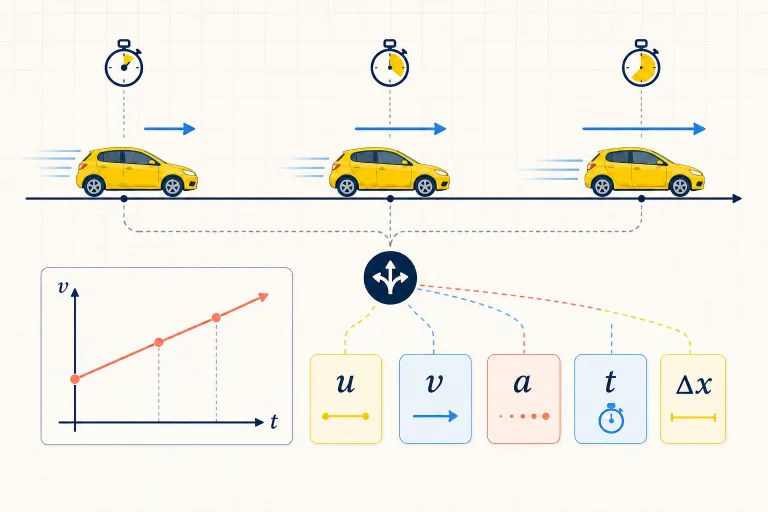
| Initial velocity, time, displacement or final velocity connected by constant acceleration | Kinematics | Acceleration must be constant for the standard equations |
| Speed changes between positions; work or height is known | Work and energy | Include relevant energy transfers; do not silently discard friction |
| Two objects collide or separate | Momentum and impulse | Momentum is conserved only if net external impulse is zero or negligible |
This table suggests starting points, not exclusive rules. A problem may allow several methods, or require two methods in sequence. Energy and Newton's laws can describe the same motion from different perspectives.
If you have already established constant acceleration and only need a formula, use our kinematics equation-selection guide. The decision here comes earlier: whether constant-acceleration kinematics is the appropriate model at all.
Worked example 1: use forces, then kinematics
Problem: A 4.0 kg cart starts from rest on a horizontal track. A constant horizontal pull of 18 N acts to the right, and a constant resistive force of 6.0 N acts to the left. Find its acceleration and its speed after 3.0 s. Assume the cart remains in contact with the track.
Choose the system: The cart. Take right as positive. Vertically, its weight and the track's normal force balance because vertical acceleration is zero. Horizontally, both the pull and resistance matter.
Choose the first principle: Newton's second law connects the net horizontal force to acceleration:
Substitute both horizontal forces:
Choose the second principle: The stated forces and mass are constant, so the horizontal acceleration is constant. We can now use :
Answer: The acceleration is to the right, and the speed after 3.0 s is .
Check: The net force points right and the cart starts from rest, so its rightward speed should increase. Force divided by mass has units of acceleration.
Common error: Using treats the applied pull as the net force. Correct algebra cannot recover the missing resistance.
Teacher prompt: “Point to the term in your equation that represents each horizontal arrow.” If a force arrow has no corresponding term, the problem is in the model setup.
Worked example 2: use energy without finding travel time
Problem: A small cart starts from rest and rolls down an ideal smooth track, dropping vertically by 1.8 m. Treat it as a particle, neglect wheel rotation and air resistance, and assume the stationary track's normal force does no work. Find its speed at the lower point. Use .
Choose the system: The cart and Earth, so gravitational potential energy belongs to the system. Set the lower point's gravitational potential energy to zero.
Choose the principle: Under the stated assumptions, mechanical energy is conserved, following the framework in OpenStax's conservation-of-energy lesson. The initial gravitational potential energy becomes kinetic energy:
Cancel the nonzero mass and solve symbolically:
Substitute the vertical drop:
Answer: The speed is approximately at the lower point.
Check: The speed does not depend on mass in this ideal model. Also, has units of squared speed, so taking the square root gives the right units.
Why this method fits: The question supplies a height change and asks for speed. We do not need the time or the detailed track shape. A curved track need not produce constant acceleration, so a constant-acceleration formula would require additional justification.
Common error: Using the track length as . Gravitational potential energy depends on vertical height, not the length traveled along the track.
Teacher prompt: “If the track were longer but had the same vertical drop, would your ideal-model answer change?” Ask students to explain using the assumptions, rather than guessing from the drawing.
Worked example 3: use momentum for a sticking collision
Problem: A 2.0 kg cart moving right at 3.0 m/s collides with a stationary 1.0 kg cart. They stick together. Assume the net external horizontal impulse during the collision is negligible. Find their common velocity just after impact.
Choose the system: Both carts together. Their collision forces are internal to this system. Take right as positive.
Choose the principle: The stated external-impulse condition permits conservation of total horizontal momentum. OpenStax's momentum lesson explains why the system boundary and external forces matter. Here:
Substitute the masses and initial velocities:
Therefore:
Answer: The joined carts move at to the right.
Check momentum: Before the collision it is . Afterward it is .
Now check kinetic energy:
The difference is 3.0 J. It is converted to other forms, such as internal energy and deformation; total energy has not disappeared. Kinetic energy is not conserved in this sticking collision.
Common error: Applying conservation of kinetic energy simply because momentum is conserved. Those are separate conditions.
Teacher prompt: “Which assumption supports momentum conservation, and which feature tells us not to conserve kinetic energy?” The two answers should be different.
Translate words into assumptions carefully
“Starts from rest” sets initial velocity to zero. “Stops” sets final velocity to zero at the specified instant. Neither statement alone implies zero acceleration.
“Smooth” usually indicates negligible friction in an idealized textbook model. “Constant speed” does not always imply zero acceleration: an object moving around a circle changes velocity direction. In straight-line motion with constant velocity, however, acceleration is zero.
“Collides” does not automatically make a system isolated. State which objects you include and whether external impulse can be neglected over the collision interval. The short duration often helps justify an approximation, but the word itself is not a conservation law.
Help students separate setup errors from calculation errors
Ask for four items before numerical work: system, sketch, principle and assumptions. A teacher can inspect those quickly without reading every algebra step.
Then label feedback according to where the solution fails. “Missing resistance” is a force-model error; “used constant acceleration without justification” is a condition error; “divided incorrectly” is arithmetic. These need different practice tasks.
For a short exit exercise, give the three scenarios above without numbers. Ask students to choose the first method and explain one condition. Follow with a new scenario combining a collision and a rise in height: momentum may apply during the impact, then energy during the subsequent rise. The time interval being analyzed matters.
Frequently asked questions
Is there always one correct equation?
No. Several valid approaches can lead to the same result. Prefer a method whose conditions are justified and whose unknowns can be determined from the information given.
Should students memorize formulas?
Knowing formulas helps, but each should be learned with its variables, units and conditions. A remembered equation used outside its assumptions can give a plausible but invalid answer.
Does checking units prove the answer is correct?
No. Unit checks catch many mistakes, but an incorrect formula can still have the right dimensions. Also check signs, limiting cases and consistency with the physical story.
Try the method on your own homework
Write your model sentence before using the physics problem solver. Compare the explanation with your chosen system and assumptions, and verify every force, direction and unit. Follow your course's rules for outside assistance.
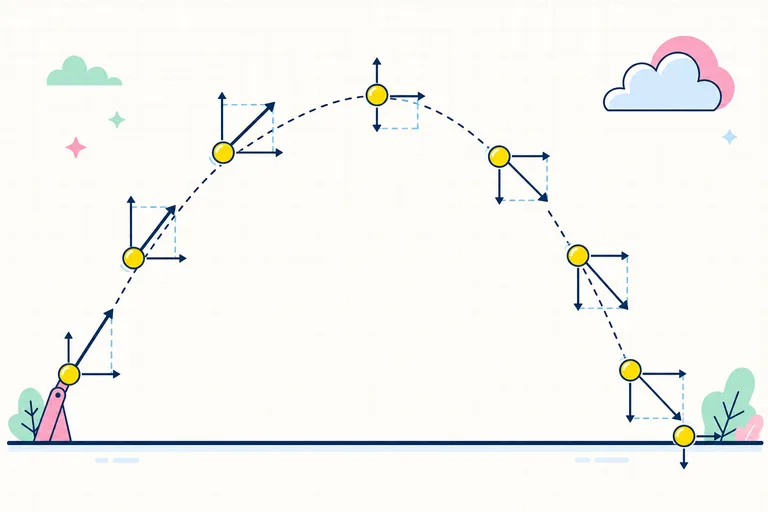
If the drawing is the difficult part, practice free-body diagram problems. For motion in two directions, continue with projectile motion problems, keeping horizontal and vertical equations separate.