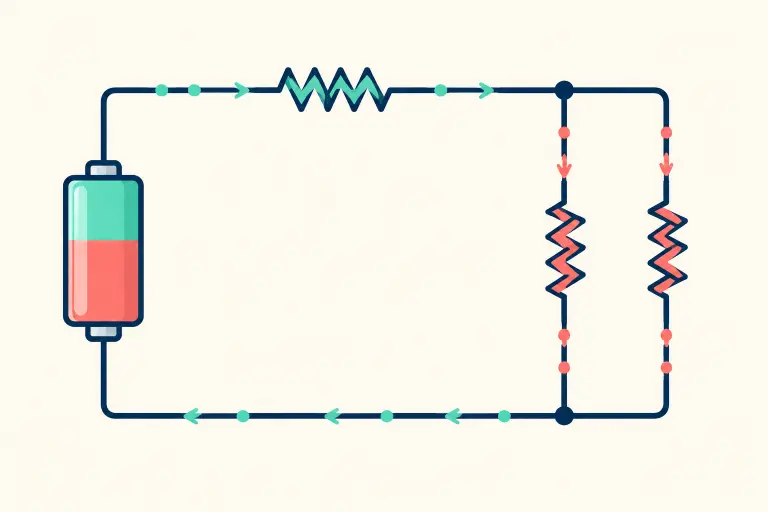
For series and parallel circuit problems, first decide which parts share a path and which parts share two nodes. In series, resistors carry the same current. In parallel, branches have the same voltage. Simplify a mixed circuit to one equivalent resistance, find total current with , then work backward to the branches.
These examples assume ideal DC sources, negligible wire resistance and resistors that obey Ohm's law. They do not cover capacitors, changing current, or non-ohmic devices. OpenStax's series-and-parallel chapter explains the underlying rules with circuit examples.
The two rules that organize the calculation
| Connection | Same quantity | Equivalent resistance | Check |
|---|---|---|---|
| Series | Current through each resistor | Voltage drops sum to source voltage | |
| Parallel | Voltage across each branch | Branch currents sum to total current |
A pair of components is in series only when no branch splits the current between them. Two components are in parallel only when both ends connect to the same two nodes. Their position on a drawing is not enough; follow the wires.
For a single resistor, the Ohm's law calculator checks . It does not analyze an entire mixed circuit or choose the right branch arrangement for you.
Example 1: two resistors in series
Problem: A V ideal battery connects to and resistors in series. Find the total current and each voltage drop.
(+ 12 V) ──[ 2 Ω ]──[ 4 Ω ]── (−)
There is one path, so . Total current is A. The same A flows through both resistors.
| Resistor | Current | Voltage drop |
|---|---|---|
| A | V | |
| A | V |
Check: V, the battery voltage. If the drops did not add to V, revisit the current or arithmetic.
Example 2: two resistors in parallel
Problem: A V ideal battery connects across and resistors in parallel. Find the branch currents, total current and equivalent resistance.
(+ 12 V) ──┬──[ 6 Ω ]──┬── (−)
           └──[ 3 Ω ]──┘
Each branch spans the same battery nodes, so each has V. Ohm's law gives A and A. The source supplies A. Then .
Check: , so . It is less than either branch resistance, as parallel equivalent resistance should be.
Example 3: a mixed series-and-parallel circuit
Problem: An V source connects to a resistor in series with a parallel pair of and . Find the total current and the current in each parallel branch.
(+ 18 V) ──[ 3 Ω ]──┬──[ 6 Ω ]──┬── (−)
                    └──[ 3 Ω ]──┘
First simplify the parallel pair:
The source sees , so A. That current passes through the series resistor, dropping V. The parallel section therefore has V across each branch.
The branch currents are A and A. Check: A, matching total current. Do not give each branch the full V; the series resistor has already used V.
Example 4: solve backward from a 24 V source
Problem: A V source connects to a series resistor, followed by parallel and branches. Find all three currents.
The parallel equivalent is . Total resistance is , so total and series current are A. The series resistor drops V, leaving V across each branch. Thus the branch currents are A and A.
Answer and check: A through the series resistor, A through the branch and A through the branch. The branch sum is A, and the series plus parallel voltage drops total V.
Three mistakes that cause most wrong answers
- Adding parallel resistances directly. Direct addition applies to series. For parallel, use reciprocal resistances or the two-resistor product-over-sum shortcut.
- Assigning the same current to parallel branches. Parallel branches share voltage, while current depends on each branch resistance.
- Using the source voltage on every part of a mixed circuit. Calculate the series voltage drop before assigning voltage to the parallel section.
The Physics Solver can help you interpret a pictured circuit, but sketch and label its nodes first. The physics resources hub has other worked problems and calculators.
Practice with answers
1. A 9 V battery connects to 1 Ω and 2 Ω resistors in series. Find current and drops.
, so . Drops are 3 V and 6 V; they add to 9 V.
2. A 10 V battery connects to 5 Ω and 10 Ω in parallel. Find both branch currents.
Both branches have 10 V. Currents are 2 A and 1 A; total current is 3 A. Equivalent resistance is .
3. Can two resistors be called parallel merely because they are drawn one above the other?
No. Their ends must connect to the same pair of nodes. Follow the wires rather than the visual orientation.