To solve for when a transversal crosses parallel lines, identify which two angles are being compared before writing an equation. Corresponding and alternate angles are equal; same-side interior angles add to . Then solve the equation and substitute your answer back into both angle expressions.
That first decision matters more than the algebra. Setting supplementary angles equal can produce a neat-looking value of that is still wrong.
The angle-pair decision table
A transversal is a line that intersects two other lines. The rules below apply when the two lines are parallel. Look at the positions of the angles relative to both intersection points; a sketch helps more than memorizing an “F” or “Z” shape.
| Pair | How to recognize it | Equation to write |
|---|---|---|
| Corresponding | Same relative corner at the two intersections | |
| Alternate interior | Between the parallel lines, on opposite sides of the transversal | |
| Alternate exterior | Outside the parallel lines, on opposite sides of the transversal | |
| Same-side interior | Between the lines, on the same side of the transversal |
At one intersection, vertically opposite angles are equal and a linear pair adds to . These two facts do not require the second line to be parallel.
If the drawing has no parallel-line marks and the question does not say the lines are parallel, do not assume they are. You can sometimes use equal corresponding or alternate interior angles in reverse to prove that the lines are parallel.
Example 1: corresponding angles
Problem: Two parallel lines are cut by a transversal. Corresponding angles are labeled and . Find and the angle measure.
Corresponding angles are equal, so
Move the variable terms to one side: , so . Substitution gives and . Both expressions agree, and is a possible angle measure.
Example 2: alternate interior angles
Problem: Alternate interior angles are and . Find .
Because the lines are parallel, the two angles are equal:
Check: Both angles equal . If you had added the expressions to , you would have used the wrong angle relationship.
Example 3: same-side interior angles
Problem: Same-side interior angles are and . Find and both angles.
These angles are supplementary:
The angles are and . Their sum is , which checks the result. They are not equal, so solving with an equals sign between the original expressions would fail.
Example 4: find x so the lines become parallel
Problem: Two lines cut by a transversal are not stated to be parallel. Corresponding angles are and . What value of makes the lines parallel?
The converse of the corresponding-angles rule says that equal corresponding angles imply parallel lines. Set them equal for the requested condition:
Each angle is . The answer is a condition for parallelism; we did not quietly assume the lines were parallel at the start.
Common mistakes and quick checks
- Using the picture's appearance as proof. Lines that look parallel may not be stated or marked as parallel. Read the givens.
- Comparing the wrong pair. Mark whether each angle is interior or exterior, then check which side of the transversal it lies on.
- Stopping at x. If the question asks for an angle, substitute into its expression. An algebra value such as is not automatically .
- Forgetting a basic angle check. Ordinary angles in these problems should generally lie between and ; equal pairs must match, and supplementary pairs must total .
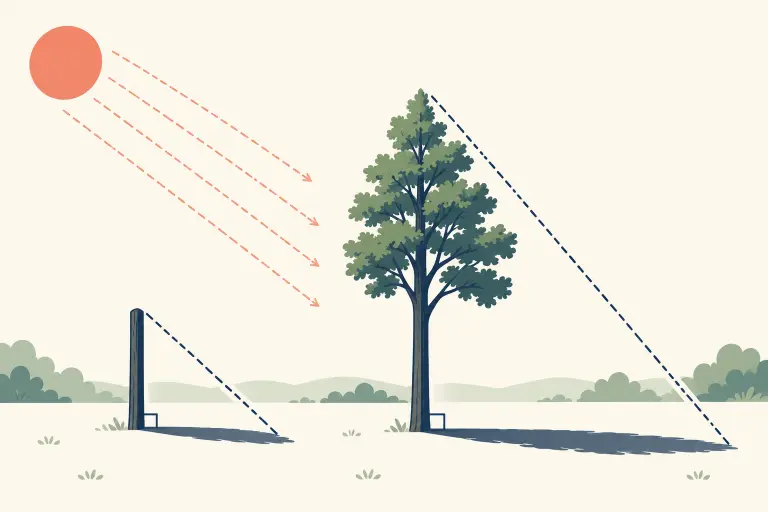
These angle relationships also help establish AA similarity. Once two triangles have two matching angles, their corresponding sides can be compared in similar-triangle word problems. For a broader proof workflow, see geometry proofs and triangle congruence.
Practice: solve, then reveal the reasoning
Try each equation before reading the answer. The labels state the relationship, so you can practice choosing the correct operation.
1. Alternate exterior angles: (2x + 20)° and (5x − 25)°. Find x.
Alternate exterior angles are equal: . Thus and . Both angles measure .
2. Same-side interior angles: (4x + 10)° and (2x + 20)°. Find x.
They add to : , so . The angles are and .
3. A linear pair: $x + 35$° and (2x − 5)°. Find x.
A linear pair adds to even without parallel lines: . Therefore ; the angles are and .
Need to interpret a diagram from your homework? The Geometry Solver can help you work through a pictured problem, while the geometry resources hub collects related guides and tools. Check the angle relationship yourself before trusting any generated answer.
Reference: Math Warehouse's parallel-line practice provides additional diagrams for recognizing corresponding and alternate angles.