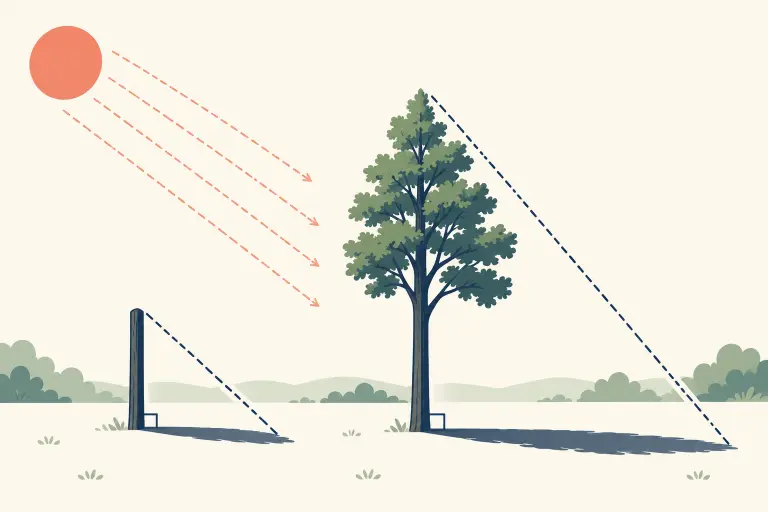
Similar-triangle word problems become manageable when you do three things in order: prove the triangles are similar, match corresponding sides, and write one consistent proportion. For example, if a m pole casts a m shadow while a tree casts a m shadow at the same time, the tree's height is m because .
The hard part is often choosing the sides, not cross-multiplying. A ratio that pairs a height with a shadow in one triangle must pair a height with a shadow in the other.
Why are the triangles similar?
In a standard shadow problem, both upright objects make right angles with level ground. If the sunlight reaches them at the same angle at the same time, each triangle has a second equal angle. The AA similarity rule then says the triangles have the same shape, although one may be larger.
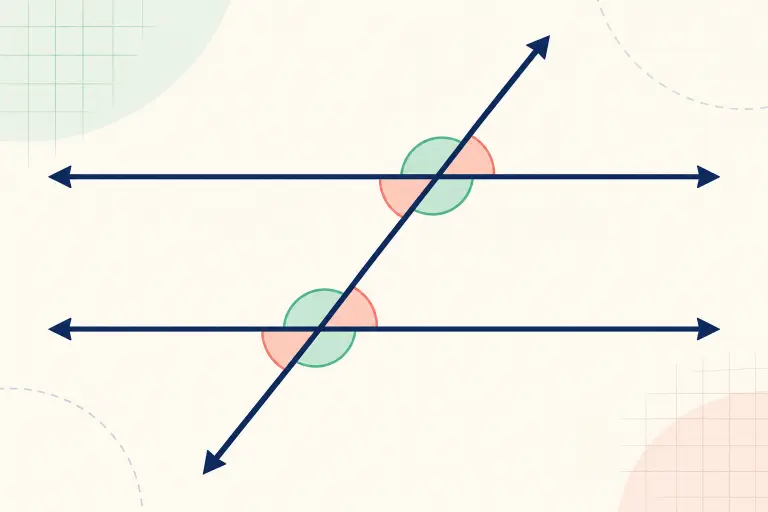
Other problems may state that a segment is parallel to a side of a larger triangle. Parallel-line angle relationships can then give a second equal angle and establish AA similarity. Do not infer similarity only because two sketches look alike.
Once similarity is established, corresponding sides have one scale factor. Write the side names or physical meanings before substituting values:
You could invert both fractions and still be correct. Inverting only one breaks the correspondence.
Example 1: height of a tree from shadows
Problem: A m vertical pole casts a m shadow. At the same time on level ground, a tree casts a m shadow. How tall is the tree?
The pole and tree are the corresponding heights; the two shadows are the corresponding bases. With for the tree height,
Check: The larger shadow is times the smaller one, so the height should also be times as large: m. This scale-factor check catches inverted proportions.
Example 2: indirect measurement across a gap
Problem: A surveyor makes two right triangles using the same straight sight line and parallel baselines. In the nearby triangle, the perpendicular side is m and the baseline is m. The corresponding baseline in the larger triangle is m. Find its perpendicular side .
The triangles share the sight-line angle and each has a right angle, so they are similar by AA. Match perpendicular to perpendicular and baseline to baseline:
Check: The larger baseline is five times the smaller one, so the perpendicular side must be m. If the measurement is intended to represent a river width, the survey setup must actually make the width perpendicular to the bank; otherwise the number describes some other distance.
Example 3: solve an algebraic similar-triangle problem
Problem: Corresponding heights are cm and cm. Their corresponding bases are cm and cm. Find and the shorter height.
The height-to-base ratios are equal:
Multiply by : , so and the shorter height is cm. The larger triangle is twice the size of the smaller: . Notice that the question asks for both and a length; they are different numbers here.
Example 4: find two missing sides from one scale factor
Problem: A smaller right triangle has sides , , and cm. A similar larger triangle has a side of cm corresponding to the cm side. Find its other two sides.
The scale factor from small to large is . Multiply every corresponding side by :
The larger triangle's sides are , , and cm. As a second check, . This check is available because these particular triangles are right triangles; similarity itself does not require a right angle.
When the shortcut does not apply
Shadows measured at different times may have different sun angles, so the two triangles need not be similar. A sloping ground surface or leaning object also changes the right-angle assumption. State the physical assumptions in a real measurement task instead of treating every shadow as a guaranteed proportion.
Do not confuse similar with congruent: congruent triangles match in shape and size, while similar triangles can have different side lengths. The triangle-congruence guide explains the proof distinction. The Pythagorean word-problem guide is useful when a single right triangle's side lengths are the focus.
Practice with answers
1. A 2 m stick casts a 3 m shadow; a building casts a 24 m shadow. Find its height.
At the same time on level ground, , so m. The shadow scale factor is ; the height scale factor is also .
2. Corresponding sides are 7 cm and 21 cm. A second side in the small triangle is 5 cm. Find its match.
The scale factor is . The matching side is cm.
3. Two triangles merely look the same shape in a sketch. Is that enough to set up a proportion?
No. You need a justified similarity condition, such as two equal angles (AA), proportional corresponding sides with an included equal angle (SAS similarity), or all three corresponding side ratios equal (SSS similarity).
For a diagram you need help reading, use the Geometry Solver and compare its side correspondence with your own labels. More related guides are in geometry resources.
Reference: Khan Academy's similarity lessons cover AA, SAS and SSS similarity and additional practice.